Three pieces of evidence, and the plain limits of the set.
Series 05
3 cases
Imaging and real-time 3-D that clinicians review. A national public-health platform delivered to a fixed date. A high-volume behavioural-health product carrying sensitive personal data. That is the set — three cases, described properly, instead of twenty capability bullets.
Medical 3-D avatars — photo-realistic patients generated from standard medical images
Anchor case · Stealth-mode
Silicon Valley company
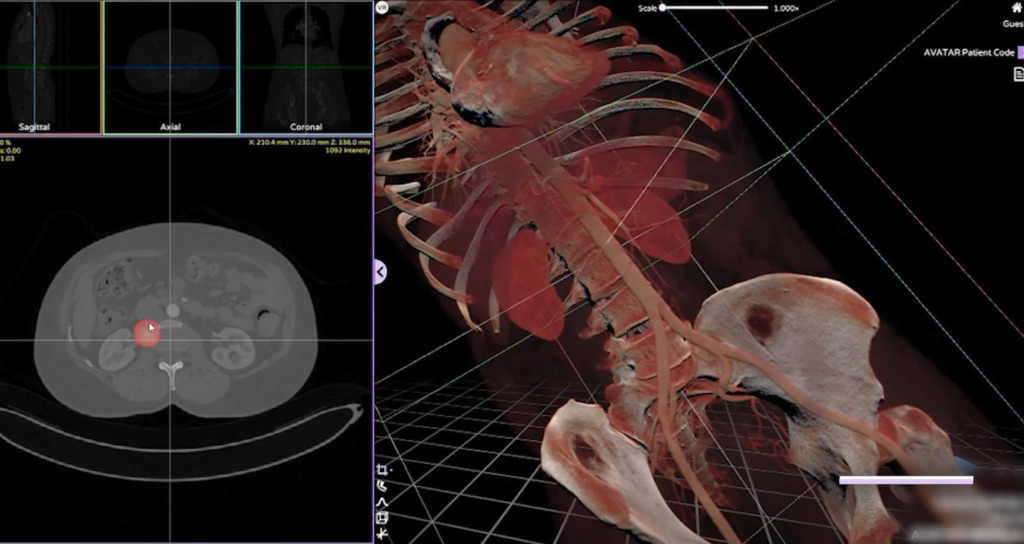
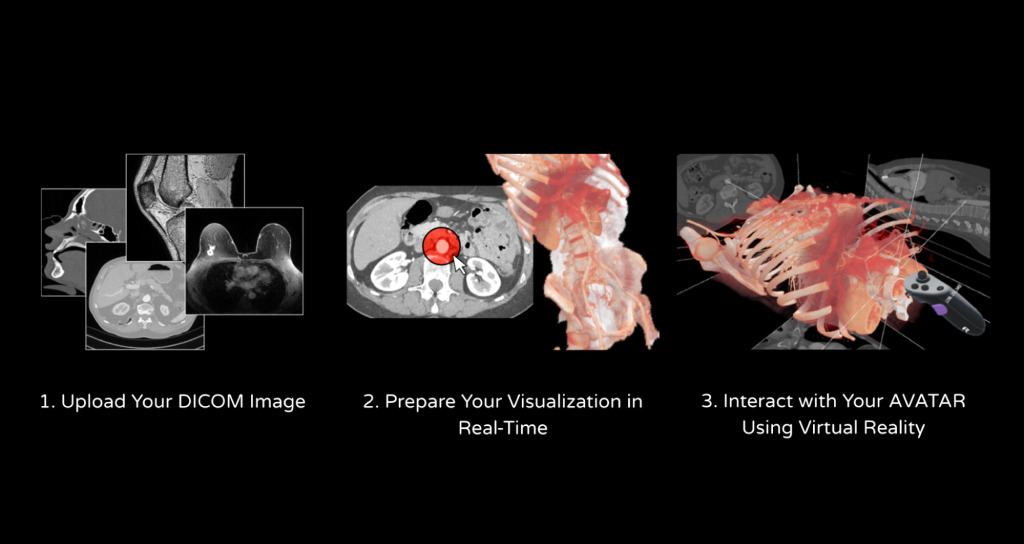
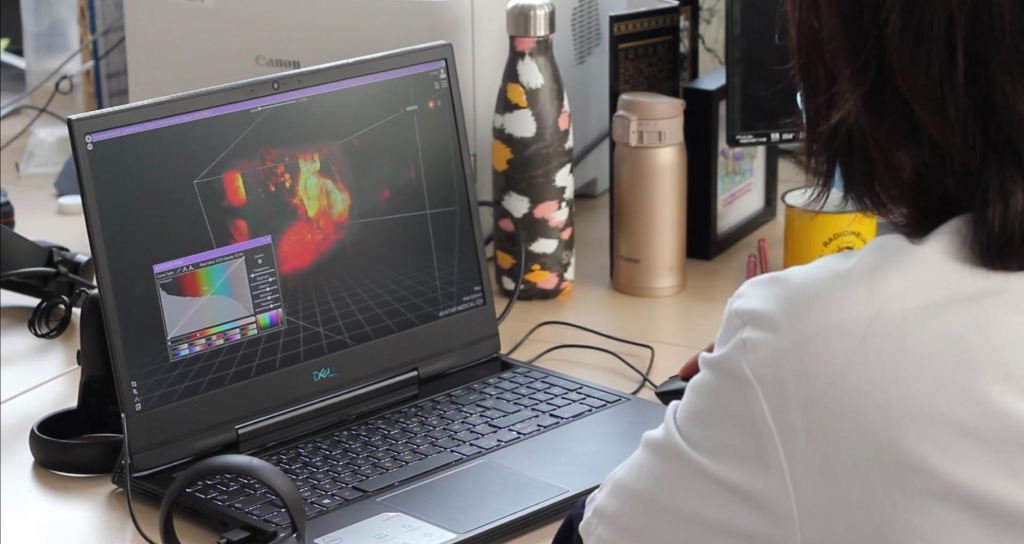
The product turns a patient’s own CT or MRI series into an interactive three-dimensional avatar a clinician can walk around, cut through and rehearse against, in 2-D, 3-D and VR viewers running in parallel. The hard part is not the rendering demo. It is that the output is reviewed by people who operate for a living, and their standard of proof is anatomical, not aesthetic.
The pipeline carries a DICOM series through windowing and threshold choices into segmentation, then to surface extraction and mesh generation, then to something that holds an interactive frame rate on hardware a teaching hospital actually owns. Every one of those stages is a place to lose the thing the reviewer is looking for. Decimate too hard and the landmark a surgeon navigates by is gone. Smooth too much and a vessel stops branching where it branches. Get the material response wrong and tissue reads as plastic, which is the fastest way to lose a room. So the engineering discipline is to make each trade-off explicit and reversible — a documented list of where fidelity was exchanged for performance, so a clinical reviewer can argue with a decision instead of guessing that something is off.
This is C++, imaging and real-time rendering work held to a clinical standard of review. It is built for training and rehearsal. It is not a diagnostic tool, it is not cleared for clinical decision-making, and we will not imply otherwise.
Input
Standard CT and MRI series
Output
Interactive 3-D patient in 2-D, 3-D and VR
Review standard
Anatomical correctness, judged by surgeons
Client
Named nowhere — the company is in stealth
Read the medical 3-D avatars case → National epidemic control platform
National public-health platform
Fixed date
A national platform managing inbound travel and public-health protocols during the pandemic: traveller submissions, protocol enforcement, and the operational reporting behind both — at the scale of everyone entering a country. Read it here as a data-protection problem first. A health declaration is sensitive personal data by any definition, including GDPR Article 9; this system held them for an entire travelling population, and the population had no alternative route. That changes what “handled carefully” has to mean: minimum-necessary access, an audit trail that answers who read which submission, retention that ends, and a boundary drawn around every party that touches the data.
The second half of the problem is that the rules changed while it was running. Protocols were rewritten by policy, sometimes at short notice, and the platform had to follow them without a maintenance window — which is an architecture decision made long before the first change request, not an operational heroic. And the launch date belonged to a border reopening, so the negotiable variable was scope, never quality and never the day.
Scale
Everyone entering the country
Data
Health declarations — sensitive personal data
Constraint
A date set by policy, and protocols that moved
Read the case → Relationship-support platform — memberships, expert sessions and behavioural programmes at scale
Client confidential
Wellbeing, not clinical care
Placed accurately: this is not a clinical system Memberships, scheduled sessions with experts, structured behavioural-science programmes and cohorts, plus the whole operational layer underneath — scheduling, content delivery, progress, billing and support — running at consumer volume. There is no diagnosis in it, no treatment, and no clinical record. It is wellbeing and behavioural support, and we are not going to let a section heading blur that line.
What it is honest evidence of: that we build sensitive, personal, high-volume products for people talking about the hardest parts of their lives, with the access control, the retention rules and the tone that requires — and that we know exactly where the boundary between wellbeing software and clinical software sits, because knowing it is the reason we can be trusted on the other side of it.
Category
Behavioural and wellbeing — explicitly non-clinical
Shape
Memberships, sessions, cohorts, programmes
Read the relationship-support platform case →