

Voice AI Agents
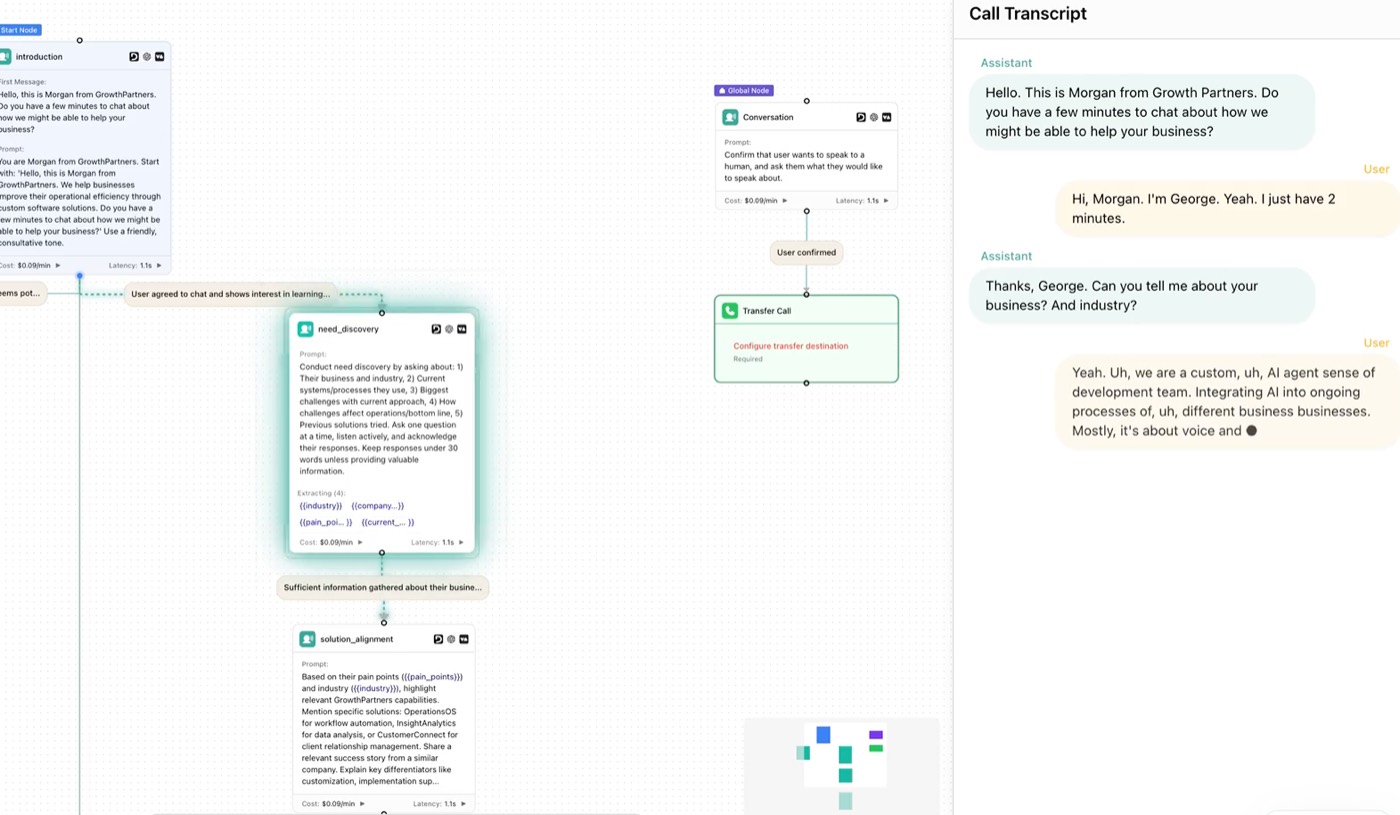
A voice AI agent answers your phone around the clock — qualifying callers, booking appointments, resolving routine requests — and hands the conversation to a human the moment it should. We have built and shipped one in production: speech in, reasoning in the middle, speech out, with handover rules for the calls it must not take.
The free 30-minute session maps your call flows — volumes, peak hours, the requests that repeat — and tells you honestly which calls an agent should take and which it never should. You keep the notes either way.
The calls you are losing right now
The phone rings after hours and the caller books elsewhere
Half of service businesses win or lose the job on who answers first. Voicemail is where prospects go to call your competitor — an after-hours caller with a booking intent is the most expensive call to miss.
Reception answers the same twenty questions all day
Opening hours, prices, availability, directions, appointment changes. Skilled staff spend their day on calls with fully scripted answers, while the calls that need judgment wait in the queue behind them.
Peaks bury the line, quiet hours waste it
Call volume arrives in bursts — campaign launches, Monday mornings, weather events. Staffing for the peak is unaffordable; staffing for the average means the peak rings out. An agent absorbs the burst and costs nothing in the quiet.
The last voice bot embarrassed the brand
Callers remember IVR mazes and bots that loop. The difference in this generation is real understanding plus an honest handover rule: the agent takes the calls it can complete, and transfers the rest with context — fast, and without pretending.

The call your team misses at 6 p.m. is the clearest revenue leak in a service business. Answering it costs an agent nothing extra.
What you get
A voice agent on your real phone number
Inbound and outbound, connected to your existing telephony — no rip-and-replace. Natural speech in your brand tone, in the languages your callers use.
You get: the agent live on your number, with recordings and transcripts of every call.
Actions, not just answers
Booking into your calendar, looking up an order, creating a ticket, taking a structured message — wired into the systems you already run, with every action logged.
You get: integrations to calendar, CRM and ticketing, each action auditable.
Handover rules in writing
The calls the agent must not take — complaints, emergencies, high-value negotiations — are defined before launch, and transfer to a named human with a live summary of the call so far.
You get: a written call-routing boundary your operations lead signs.
Numbers you can manage by
Answer rate, completion rate, transfer rate, cost per call against the human baseline — read out honestly, from day one.
You get: a dashboard of the metrics the agent is accountable to.
How it works
Map the call flows
We listen to real recordings, count the request types, and pick the call types the agent takes first — the scripted, high-volume ones.
Build and rehearse
The agent is built against your actual FAQs, systems and edge cases, then rehearsed on recorded scenarios until the transfer rules hold.
Launch supervised
Live on a subset of calls with humans monitoring transcripts; the scope widens as the numbers hold.
Measure and extend
More call types, outbound reminders, additional languages — each addition judged on the same numbers.
Answered on the first ring, every time.
Proof, not claims
This page is backed by a shipped system, and by the voice, avatar and telephony work around it.
The voice agent we built and shipped
Real-time speech recognition, LLM reasoning, natural speech out — answering real calls with handover rules for the ones it should not take. The case page includes a recorded call.
Voice conversation with a live 3D character
TTS/STT voice wired to an LLM and an animated avatar that teaches children French — the same voice pipeline, pushed further into real-time interaction.
A voice agent answers on the first ring at 3 a.m. for the same cost per call as at 3 p.m. — and hands off to a human the moment the call leaves its script.

The transfer rule is the product: the agent completes the calls it can, and hands the rest to a human with context — fast, and without pretending.
Scope the first call types on a free session
One 30-minute session with an engineer maps your call flows and picks the call types where an agent pays first. The build is then scoped in writing, priced before anything starts, and launched supervised.
You get the call-flow map and our honest read on agent-vs-human routing either way. Nobody follows up more than once.
Clients also buy
AI Agent Development
Production agents with defined boundaries and measurable ROI — not demos. An Agent Pilot in 30 days.
Video AI Agents
Digital humans and AI avatars that present, teach and sell on camera — built on real production cases.
Chatbots & RAG
Assistants that answer from YOUR knowledge base, with retrieval you can audit — and a clear line to agents when you need one.
The team that ships your voice agent answers to the same discipline it sells: boundaries in writing, numbers on a dashboard.
The questions buyers actually ask
Will callers know they are talking to an AI?
Yes — the agent introduces itself honestly, which callers reward with clearer requests. The trust-killer is a bot pretending to be human, and an honest agent that resolves the call in one minute beats a hold queue every time.
What happens when a call goes off script?
The agent transfers to a named human with a live summary of the conversation so far, or takes a structured message when nobody is available. The calls it must never attempt — complaints, emergencies, negotiations — are written into the routing boundary before launch.
Does it work with our existing phone system?
Yes — we connect to your current number and telephony provider rather than replacing them. Calendar, CRM and ticketing integrations ride over the APIs you already have.
Which languages can it speak?
The major European languages and English are production-ready; others are evaluated per project against real recordings. Accent and noise tolerance are tested on your actual call audio before launch, not assumed.
What does it cost to run?
A per-call cost that we model against your volumes during scoping, plus a monthly operating fee. The dashboard shows cost per handled call next to your human baseline, so the economics stay visible instead of assumed.
How long until it takes real calls?
The supervised launch typically lands in about four weeks from kickoff, starting with the highest-volume scripted call types. Widening the scope is a data-driven decision after that.
What AI can actually carry in your business — the one-page version
The nine AI & Agents services on one printable page: what each one is, the situation it answers, and the first engagement that proves it. Built to be forwarded to whoever holds the budget.
Your calls, answered around the clock
Book the free 30-minute session and we map your call flows and the agent-vs-human routing — or write two sentences about the calls you miss today, and an engineer replies in one business day.
- 30 minutes, an engineer on the call
- You keep the written notes either way
- Nobody follows up more than once